Whole-Body Vibration for Children with Cerebral Palsy
What is whole-body vibration?
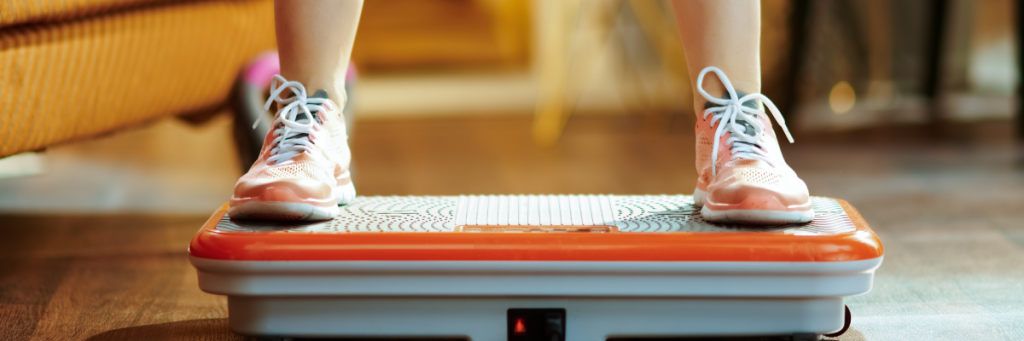
Whole-body vibration (WBV) is a training method in which a person stands, sits, or performs exercises on a platform that produces repeated mechanical vibrations. These vibrations are transmitted through the body and cause rapid changes in muscle length, which can stimulate muscular and neuromuscular responses.
One widely used device for whole-body vibration training is the Galileo, a side-alternating vibration platform. Unlike platforms that move the whole surface up and down simultaneously, the Galileo tilts around a central axis, similar to a seesaw. As one side moves upward, the other moves downward, producing alternating movements of the left and right legs that resemble the loading pattern occurring during walking.
The training stimulus can be adjusted mainly through the frequency of the vibration (Hz), the amplitude of the movement, and the person’s position on the platform. These parameters determine how strongly the vibration is transmitted to the body and form the basis for different therapeutic and training applications.
What is Cerebral Palsy?
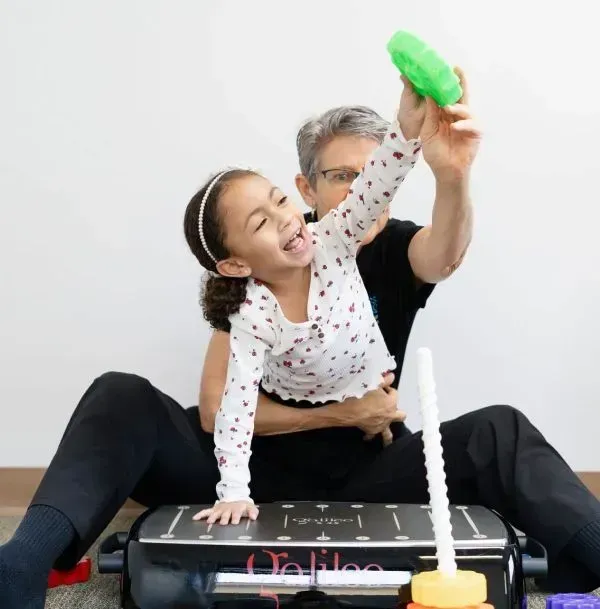
Cerebral palsy (CP) describes a group of permanent disorders affecting movement and posture caused by non-progressive disturbances in the developing fetal or infant brain. Depending on the affected brain areas, CP can lead to problems with muscle tone, coordination, balance and selective motor control. The most common motor type is spastic CP, characterized by increased muscle tone and exaggerated reflexes. Other forms include dyskinetic and ataxic CP. Although the underlying brain disturbance is non-progressive, a person’s functional abilities and secondary musculoskeletal problems can change throughout life.
The Physiology of Whole-Body Vibration
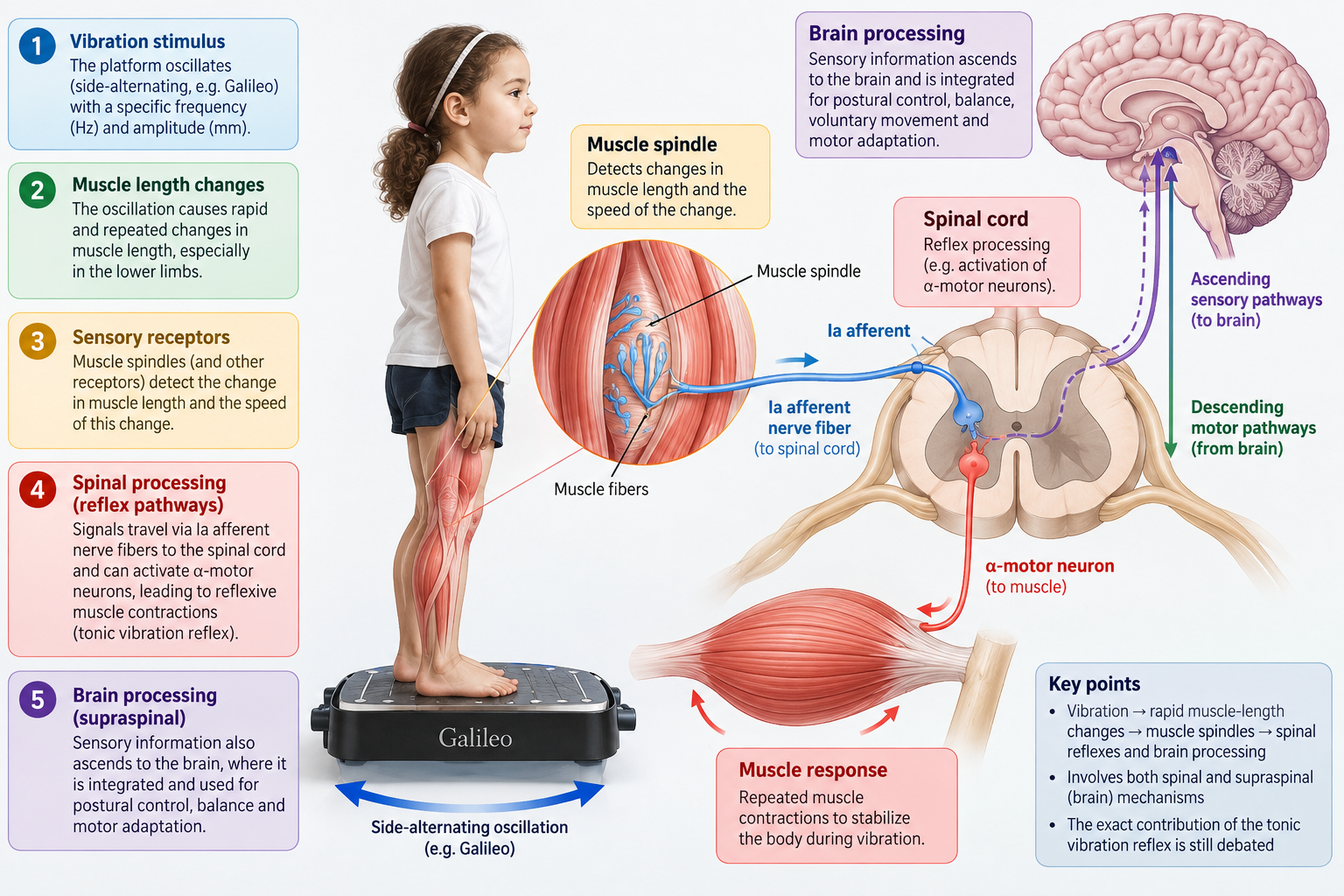
When standing on a WBV platform, the repeated movement of the platform causes small and rapid changes in muscle length. These mechanical stimuli activate sensory receptors within the muscles, particularly muscle spindles, which are sensitive to changes in muscle length and the speed of those changes.
Signals from the muscle spindles travel through Ia afferent nerve fibers ( 70–120 m/s) to the spinal cord, where they can influence alpha motor neurons and contribute to reflexive muscle activation. Traditionally, this response has been associated with the tonic vibration reflex (TVR). However, research suggests that the neuromuscular response to whole-body vibration is more complex and cannot be explained by the classic TVR alone. Both spinal reflex pathways and higher levels of the central nervous system may contribute to the body’s response to vibration.
During WBV, muscles continuously adjust their activity to maintain posture and stability. The magnitude of this neuromuscular response depends on several factors, including frequency, amplitude, body position, muscle activation and the characteristics of the vibration platform.
Evidence for Whole-Body Vibration in Children with Cerebral Palsy
Several studies have investigated whether WBV can improve motor function in children with cerebral palsy. In a randomized controlled trial, Lee and Chon (2013) compared conventional physiotherapy with physiotherapy combined with WBV in 30 children with CP. After eight weeks, the WBV group showed improvements in walking speed and stride length (2 steps) as well as increased thickness of the tibialis anterior and soleus muscles. Walking speed, for example, increased from 0.37 m/s to 0.48 m/s.
However, not all studies have demonstrated an additional benefit from WBV. A more recent randomized controlled trial investigated Galileo WBV combined with intensive therapeutic exercise. While both groups improved during treatment, adding WBV did not result in significant additional improvements in functional capacity compared with intensive therapy alone. This suggests that WBV should be considered an adjunct to active therapy rather than a replacement for it, and its additional benefit may depend on the population and training protocol.
Looking at the evidence as a whole, a 2025 systematic review and meta-analysis included 23 randomized trials with 729 children with CP. WBV was associated with significant improvements in walking speed, Timed Up and Go, gross motor function (GMFM) and postural stability compared with control interventions. No intolerable adverse effects were reported. However, the authors rated the certainty of the available evidence as low to very low, partly because studies differed substantially in their training protocols and methodology. Therefore, current research suggests that WBV can be a useful complementary intervention for improving certain aspects of motor function in children with CP, while stronger and more standardized trials are still needed.
WBV may be particularly attractive in very young children with CP, as conventional strength training and repetitive exercise can be difficult to implement at this age. However, current evidence does not yet demonstrate a greater treatment effect in toddlers and preschool children. Early motor development appears to benefit particularly from active, task-specific and child-initiated practice, while WBV may be better viewed as a complementary neuromuscular stimulus rather than a substitute for active motor training.
Frequency and Training Position
Frequency and body position are two important parameters that determine the intensity and character of WBV training. Frequency describes how many oscillations occur per second and is measured in Hertz (Hz). On the Galileo, low frequencies of approximately 5–10 Hz are primarily used for mobilisation and balance, while 12–20 Hz are intended to stimulate muscle function and coordination. Higher frequencies of approximately 25–40 Hz are used when greater muscle activation, strength and power are the training goals. These ranges should not be regarded as strict physiological boundaries, however, and research in children with cerebral palsy has not yet established one optimal frequency.
Body position is equally important. Standing upright, squatting or performing dynamic exercises changes which muscles are pre-activated and how the vibration is transmitted through the body. On a side-alternating Galileo platform, moving the feet farther away from the central axis also increases the amplitude and therefore the mechanical stimulus. A systematic review of WBV protocols in people with CP found that standing was the most common position, followed by squatting and combinations of standing with dynamic exercises. However, protocols varied considerably between studies, including differences in frequency, amplitude, position, session duration and overall treatment duration.
Therefore, WBV cannot be defined by frequency alone. Frequency, amplitude, body position and exercise selection work together to determine the training stimulus, and the optimal combination for children with cerebral palsy remains uncertain.